
Oligo Fucoidan
Everything you need to know about the low-molecular-weight brown seaweed extract (Oligo Fucoidan) that has generated over 60 clinical studies — from its ocean origins to its potential role in cancer care, immunity, and chronic disease management.
📋 Table of Contents
1. What Is Oligo Fucoidan?

Oligo Fucoidan is a low-molecular-weight (LMW) form of fucoidan, a sulfated polysaccharide naturally found in the cell walls of brown seaweeds such as kelp, wakame, and mozuku. The term "oligo" (from the Greek for "few") refers to the shortened chain length of the molecule — typically less than 10 kilodaltons (kDa) — compared to regular fucoidan, which can reach molecular weights of 50–1,000 kDa.
Fucoidan itself was first documented in 1913 by Swedish Professor Harald Kylin, who identified the characteristic slimy film on seaweed surfaces. For most of the 20th century, research focused primarily on high-molecular-weight forms. It was only in more recent decades that scientists recognized an important insight: smaller molecules often penetrate biological barriers more effectively, prompting a focused push to study the oligomeric form.
Brown seaweeds — classified as Phaeophyta — are among the richest sources. Species like Laminaria japonica (kombu), Undaria pinnatifida (wakame), Fucus vesiculosus (bladderwrack), and Cladosiphon novae-caledoniae (mozuku) have been the focus of most commercial extraction efforts.
🔑 Key Definition
Oligo Fucoidan = Low-Molecular-Weight Fucoidan (LMW-F) — a water soluble biologically active, more bioavailable fragment of the larger fucoidan molecule, produced via enzymatic or acid hydrolysis of standard fucoidan. Molecular weight is typically under 10 kDa, with the most studied variants around 800 Da to 8 kDa.
2. Oligo Fucoidan vs. Regular Fucoidan: What's the Difference?
Understanding why "oligo" matters requires a brief look at how molecular weight influences how a compound behaves once inside the human body. Regular (high-molecular-weight) fucoidan is a large, complex polysaccharide. While it has documented biological activities, its large size can limit how much of it is absorbed through the gut lining into systemic circulation.
Oligo Fucoidan, by contrast, has been fragmented — either enzymatically or through mild acid hydrolysis — into shorter chains. This process preserves the core fucose-and-sulfate structure while making the molecule smaller, lighter, and considerably more soluble in water.
| Feature | Regular Fucoidan | Oligo Fucoidan (LMW) |
|---|---|---|
| Molecular Weight | 50 – 1,000 kDa | < 10 kDa (often ~800 Da – 8 kDa) |
| Bioavailability | Moderate (gut absorption limited) | Higher — better gut permeation |
| Water Solubility | Moderate | High |
| Immunomodulation | ✔ Present | ✔✔ Enhanced |
| Anti-inflammatory | ✔ Present | ✔✔ Enhanced |
| Clinical trial data | Limited | Growing (30+ cancer-related papers) |
| Taste/Tolerability | Can be bitter/viscous | Better tolerated orally |
Research from multiple institutions consistently supports that lower molecular weight enhances biological activity in fucoidan compounds. The increased surface-area-to-mass ratio, combined with greater aqueous solubility, allows oligo fucoidan to interact more readily with cellular receptors and signaling pathways.
3. The Science: How Oligo Fucoidan Works in the Body
Oligo Fucoidan's wide-ranging effects stem from a relatively small set of core molecular mechanisms. Once absorbed, these short-chain sulfated polysaccharides interact with cell surface receptors, signaling proteins, and immune cells in ways that cascade into a variety of downstream health outcomes.
3.1 Structural Chemistry
The backbone of fucoidan consists of repeating disaccharide units: α-1,3-linked L-fucose and α-1,4-linked L-fucose, with sulfate groups attached at the C-2 and C-4 positions. This sulfation pattern is critical — it gives fucoidan its negative charge and is largely responsible for its biological activity, much like the anticoagulant heparin, which shares structural similarities.
3.2 Key Mechanisms of Action
-
1
Immune System Modulation (Bidirectional): Oligo Fucoidan exhibits a remarkable "bi-directional" immunomodulatory effect — it can both stimulate underactive immune responses and dampen overactive ones. It activates natural killer (NK) cells and cytotoxic T-lymphocytes (CTLs), while simultaneously downregulating excessive inflammatory cytokines like IL-6 and TNF-α.
-
2
Anti-inflammatory Pathway Inhibition: Research shows that oligo fucoidan suppresses key inflammatory enzymes including iNOS (inducible nitric oxide synthase) and COX-2 (cyclooxygenase-2), as well as the inflammatory cytokine MCP-1/CCL2. These enzymes are central mediators of chronic low-grade inflammation linked to numerous modern diseases.
-
3
Antioxidant Activity: As a free radical scavenger, fucoidan protects cells against oxidative stress by neutralizing superoxide radicals. It also upregulates the body's own antioxidant defense system — specifically heme oxygenase-1 (HO-1), a protective enzyme that reduces cellular oxidative damage.
-
4
Apoptosis Induction in Cancer Cells: In cancer cells, oligo fucoidan promotes apoptosis (programmed cell death) via the mitochondria-mediated pathway, and triggers reactive oxygen species (ROS)-dependent JNK activation. Crucially, it does this while sparing healthy cells from significant damage.
-
5
Anti-Angiogenic Effects: Tumor growth depends on the formation of new blood vessels (angiogenesis). Oligo fucoidan inhibits P-selectin and vascular endothelial growth factor (VEGF), effectively cutting off the blood supply that tumors need to grow and spread.
-
6
Anti-fibrotic Signaling: In kidney and liver cells, oligo fucoidan downregulates the TGF-β/Smad pathway — a key driver of tissue fibrosis. By inhibiting this pathway, it may slow the progression of fibrotic diseases in multiple organs.
🔬 Scientific Note
Oligo Fucoidan's structural similarity to heparin (a well-known anticoagulant drug) explains many of its vascular and anti-inflammatory properties. However, unlike heparin, fucoidan can be taken orally, making it far more practical as a long-term supplement.
4. Top 8 Evidence-Based Health Benefits of Oligo Fucoidan
Based on scientific research — including double-blind randomized controlled trials, preclinical studies, and clinical observations — here are the key health areas where oligo fucoidan has demonstrated the most compelling evidence.
Immune Support
Enhances NK cells, T-lymphocytes, and CD19 B-cell populations for comprehensive immune defense.
Anti-Inflammation
Suppresses IL-6, TNF-α, COX-2, and other inflammatory markers associated with chronic disease.
Cancer Adjunct
Improves disease control rates and reduces chemotherapy side effects in clinical trials.
Kidney Protection
Inhibits fibrotic signaling pathways to slow chronic kidney disease progression.
Cardiovascular Health
Mild anti-thrombotic effects; may reduce LDL cholesterol and diastolic blood pressure.
Respiratory Health
Improves Th1/Th2 balance in asthma and reduces PM₂.₅-induced lung inflammation.
Antiviral Activity
Shows activity against influenza and hepatitis B viruses; may boost vaccine response in elderly.
Metabolic Support
Associated with improved glucose homeostasis and lipid metabolism in pre-diabetic models.
Ready to Experience the Benefits of Oligo Fucoidan?
Explore our clinically researched, pharma-grade Oligo Fucoidan supplement — trusted by thousands for immune support and overall wellness.
👉 Learn more about KYTANS SULFUCO5. Oligo Fucoidan & Cancer Support: What the Research Shows
Of all the applications studied, cancer support has attracted the most rigorous scientific attention. Researchers have investigated oligo fucoidan both as a standalone agent against cancer cells and as an adjunctive therapy alongside conventional treatments such as chemotherapy and radiation.
5.1 Landmark Double-Blind Clinical Trial (Colorectal Cancer)
In 2017, researchers at Kaohsiung Medical University completed the first double-blind, randomized controlled trial specifically evaluating low-molecular-weight fucoidan as a supplemental therapy in metastatic colorectal cancer (mCRC) patients. This milestone study included 60 eligible patients treated with the FOLFIRI plus bevacizumab regimen as first-line chemotherapy.
5.2 Lung Cancer — Survival & Quality of Life
A 2024 study published in Food & Nutrition Research examined the effects of oral oligo fucoidan administration on non-small cell lung cancer (NSCLC) patients receiving standard therapy. The fucoidan group showed a survival rate of 28.6% compared to 20% in the control group. Beyond survival, patients in the fucoidan group maintained better overall quality of life scores, and the study documented an increase in the CD19 lymphocyte population alongside lower circulating inflammatory cytokines — suggesting enhanced immune surveillance.
5.3 Mechanisms Against Tumor Cells
Laboratory and preclinical research has revealed multiple complementary mechanisms by which oligo fucoidan targets tumors:
-
A
DNA Damage Repair Support: Research using human colorectal cancer cells (HCT116) showed that oligo fucoidan treatment reduces the occurrence of spontaneous DNA lesions and promotes the accumulation of the tumor-suppressor protein p53. It also significantly decreased phosphorylation of ATM, Chk1, and γ-H2AX — key markers of DNA damage signaling — working in concert with the p53 pathway.
-
B
Reduction of Tumor Microenvironment Inflammation: Oligo fucoidan decreases tumor-promoting M2 macrophages in the tumor microenvironment and reduces pro-inflammatory cytokines IL-6 and CCL2/MCP-1, which are commonly elevated by chemotherapy. This dual effect — supporting treatment while buffering side effects — is what makes it particularly interesting as an adjunct therapy.
-
C
Inhibition of Metastasis: Fucoidan prevents the adhesion of tumor cells to the extracellular matrix, disrupting a key step in cancer metastasis. It targets P-selectin — a molecule that helps circulating tumor cells anchor to new sites — effectively limiting cancer spread.
-
D
Cancer Cachexia Management: Cancer cachexia — severe muscle wasting, fatigue, and weight loss — affects a large proportion of cancer patients and significantly impairs treatment tolerance. Preliminary research suggests oligo fucoidan may help counteract cachexia by reducing the inflammatory signals that drive it.
📌 NCI Recognition
Oligo Fucoidan has been included in the Dictionary of Drugs of the U.S. National Cancer Institute (NCI) under code C170752 — a recognition of its scientific legitimacy as a biologically active compound relevant to oncology research.
⚠️ Important Perspective
Oligo Fucoidan is not a cancer treatment or cure. All clinical research to date has studied it as a complementary or adjunctive supplement alongside — not instead of — conventional oncology treatment. Always consult your oncologist before incorporating any supplement into a cancer treatment plan.
6. Immune System Modulation: The Bidirectional Effect
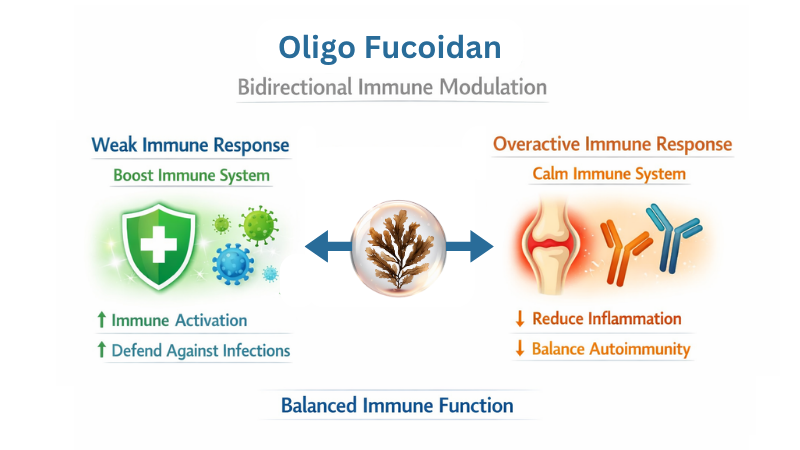
One of the most scientifically interesting features of oligo fucoidan is its ability to perform what researchers call "bidirectional immunomodulation" — meaning it can both boost an underactive immune system and calm an overactive one. This nuanced behavior is rare in natural compounds and is central to its potential in both infection defense and inflammatory/autoimmune conditions.
6.1 Asthma and Allergic Disease
A randomized, double-blind, placebo-controlled clinical trial studied the effects of oligo fucoidan in asthma patients receiving standard treatment. Previous research had established that fucoidan can shift the Th1/Th2 immune balance — a critical ratio in allergic disease — and inhibit IgE production and mast cell degranulation. The clinical trial confirmed that oligo fucoidan supplementation improved the Th1/Th2 and Treg/Th17 ratios in asthmatic patients, reduced circulating inflammatory markers, and was well-tolerated with no significant adverse events.
6.2 Respiratory Protection Against Air Pollution
A 2026 study published in Scientific Reports investigated oligo fucoidan in patients with chronic respiratory diseases associated with PM₂.₅ air pollution exposure — a highly relevant concern in industrialized regions of Taiwan and other Asian urban centers. The study found descriptive improvements in immune and inflammatory parameters, suggesting potential protective effects in pollution-associated lung conditions.
6.3 Influenza Vaccine Enhancement
Research involving elderly populations — who typically mount weaker responses to vaccines — found that fucoidan consumption prior to influenza vaccination may boost post-vaccination antibody production. This "adjuvant-like" effect on the adaptive immune response is particularly meaningful for vulnerable populations where vaccine efficacy tends to be reduced.
6.4 NK Cell Activation
Natural killer (NK) cells are the immune system's first-line assassins — they identify and destroy infected or cancerous cells without needing prior sensitization. Studies consistently show that fucoidan compounds activate NK cells and increase their cytotoxicity. Cytotoxic T-cells (CTLs) also demonstrate greater killing efficiency against cancer cells when co-cultured with fucoidan-treated dendritic cells compared to untreated controls.
7. Chronic Disease & Organ Protection
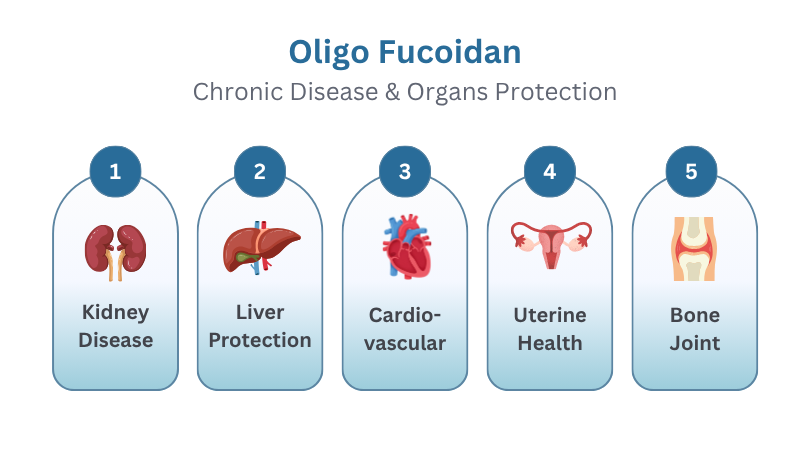
7.1 Kidney Disease (CKD)
Chronic kidney disease (CKD) is a growing global health problem, and tubulointerstitial fibrosis is recognized as its key driver. A study published in Scientific Reports investigated oligo fucoidan (~800 Da) in a mouse CKD model. Fucoidan doses below 100 mg/kg/day significantly improved renal function and reduced renal tubulointerstitial fibrosis. The mechanism was linked to inhibition of the CD44 signaling pathway, which in turn downregulated β-catenin and TGF-β — both central mediators of fibrotic scarring. A 2024 paper further investigated its potential in mitigating peritoneal dialysis-associated fibrosis.
7.2 Liver Protection
Research has demonstrated that combined supplementation with low-molecular-weight fucoidan and high-stability fucoxanthin decreases serum alanine transaminase (ALT) levels in patients with non-alcoholic fatty liver disease (NAFLD) — a condition affecting hundreds of millions globally. Additional studies suggest fucoidan protects against alcohol-induced liver injury and iron overload-related ferroptosis in the liver.
7.3 Cardiovascular Effects
In overweight and obese adults, fucoidan supplementation over three months was associated with decreased diastolic blood pressure and LDL ("bad") cholesterol, along with increased insulin secretion. Its mild anticoagulant properties — attributed to elevated prostacyclin (PGI2) secretion via increased H₂O₂ production — may also help maintain healthy blood flow and reduce thrombotic risk, though this property also necessitates caution in people taking blood-thinning medications.
7.4 Uterine Fibroids
A 2025 pilot randomized controlled trial published in Biomedicines explored marine oligo fucoidan as a functional food in managing uterine fibroids, reporting a favorable safety profile — highlighting the expanding scope of research into gynecological applications.
7.5 Bone and Joint Health
Fucoidan has been studied for its ability to prevent RANKL-stimulated osteoclastogenesis — the process by which bone-resorbing cells are activated — suggesting potential utility in osteoporosis prevention. In joint disease, low-molecular-weight fucoidan was found to inhibit the viability and invasiveness of fibroblast synoviocytes in rheumatoid arthritis models by blocking NF-κB and p38 inflammatory pathways, which drive joint destruction.
8. Dosage Guidelines & Available Forms
Determining the optimal dosage of oligo fucoidan depends significantly on the intended use, the specific product formulation, and the individual's health status. Here is a general framework based on available research:
| Purpose | Suggested Dosage Range | Evidence Level |
|---|---|---|
| General immune maintenance | 200 – 400 mg/day | Moderate (clinical + preclinical) |
| Anti-inflammatory / joint support | 600 – 1,000 mg/day | Early clinical (small trials) |
| Cancer adjunct therapy | 1,000 – 2,200 mg/day (divided doses) | Clinical trials (RCTs available) |
| Respiratory / asthma support | 400 – 800 mg/day | Clinical trial (RCT) |
| Liver / metabolic health | 300 – 600 mg/day | Moderate (clinical) |
⚠️ Dosage Disclaimer
These ranges are drawn from published research and should not be interpreted as medical prescriptions. Individual needs vary, and you should always consult a qualified healthcare provider before starting oligo fucoidan supplementation — especially at therapeutic doses or if you have existing medical conditions.
8.1 Available Forms
Oligo Fucoidan is available commercially in three main formats. Each has its own advantages depending on your lifestyle, dosage goals, and preference for convenience versus bioavailability.
-
💊
Capsules / Tablets: Convenient for daily supplementation, but quality varies significantly across products. Many only claim to “contain fucoidan” without specifying molecular weight or purity.
-
🫙
Powder: While more versatile, powders often show even greater variation in quality. Some are produced using outdated extraction methods, resulting in high levels of insoluble impurities and sugars—reducing both absorption and biological activity.
Liquid Form — Why It Stands Out
The preferred format in many clinical studies
Liquid oligo fucoidan offers several meaningful advantages over solid forms, making it the preferred choice for those seeking maximum effectiveness:
Liquids bypass the dissolution step required by capsules and tablets. The active compounds reach the gut lining more quickly, shortening the time to absorption and potentially enhancing bioavailability.
Liquid form allows easy adjustment of dosage in millilitres — ideal when following clinical protocols that specify volume-based intake (e.g., 400 mL/day as used in human trials), or when gradually titrating up from a starting dose.
Several studies — including human trials for lung cancer and inflammation — specifically used liquid oligo fucoidan preparations. Choosing this format aligns more closely with the conditions under which research benefits have been demonstrated.
For elderly patients, cancer patients during treatment, or anyone who struggles with capsules, liquid form provides a practical and comfortable alternative without compromising efficacy.
9. Frequently Asked Questions (FAQ)
What is the difference between Regular fucoidan and oligo fucoidan?
Can oligo fucoidan help in cancer care?
How should I take oligo fucoidan?
Do all oligo fucoidan supplements offer the same quality?
Not all oligo fucoidan supplements are created equal. Three key factors determine quality:
🔬 Extraction Technology & Purity
Many conventional products use older extraction methods that may contain up to
55% insoluble impurities and around 22% residual sugars.
These lower-purity forms are not aligned with the high-purity, fully water-soluble
standards used in clinical research, and are often found in powdered formats.
⚡ Bioavailability & Effectiveness
The extraction method directly impacts how well your body absorbs and uses the compound.
Higher purity means better solubility — and better solubility means the active molecules
reach your cells more efficiently.
✅ The KYTANS SULFUCO Difference
KYTANS SULFUCO utilizes a patented dual-extraction technology
to produce high-purity oligo fucoidan with superior solubility and consistency. This advanced
process has been shown to deliver performance over 3× higher compared to
conventional extraction methods — making the choice of quality a critical difference for
consumers seeking meaningful results.
Does oligo fucoidan help with the immune system?
Can I get enough fucoidan from eating seaweed?
Have More Questions About Oligo Fucoidan?
Drop your questions in the comments below — or share this article with someone who could benefit from learning about this remarkable marine compound.